
Mac Address Generator
Generate valid MAC addresses for virtual machines, containers, lab networks and test data. Choose locally administered or a vendor prefix (OUI), unicast or multicast, the output format and how many you need — then copy or download the list.
- Free to use
- No sign-up
- Runs in your browser
Generate MAC addresses
Check a MAC address
Network Addressing Reference Pack
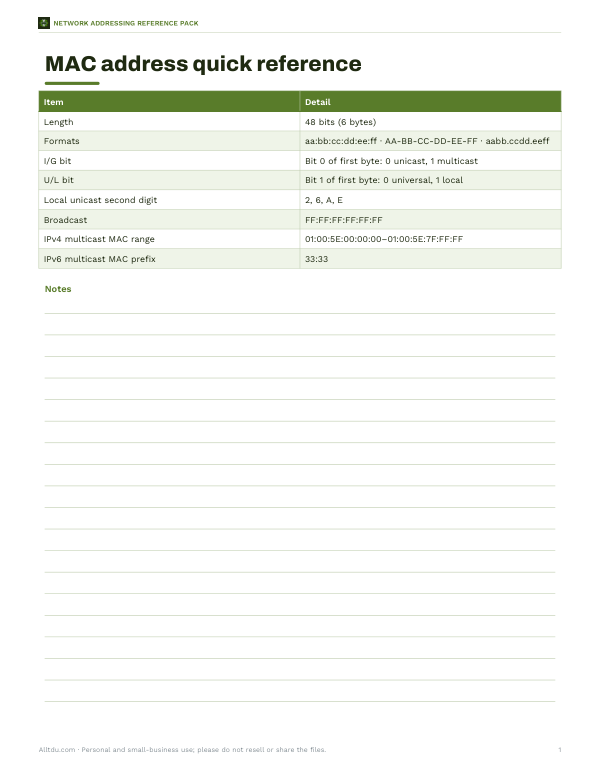
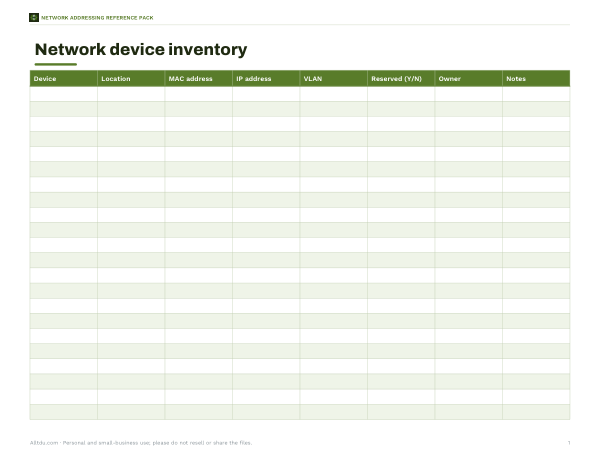
Printable MAC, IPv4 subnet and port reference sheets and an Excel device inventory with MAC and IP columns.
- MAC address reference (PDF, XLSX)
- Device inventory (XLSX, PDF)
Formats: PDF, XLSX. Instant download after payment (link valid 72 hours, up to 5 downloads). AI-assisted: the templates were drafted with AI help and reviewed and laid out before publishing.
$3.00 USD, one-time
- Instant download
- 7-day refund
- Secure checkout by Stripe
7-day money-back guarantee. Full refund within 7 days of purchase, even after you download.
Full refund within 7 days — see the refund policy and license.
Free printables
Single sheets you can print right now, no sign-up. The full pack adds every sheet in one download plus the editable files.
What a MAC address is
A MAC (media access control) address is the 48-bit hardware address used by Ethernet, Wi-Fi and many other networks to deliver frames to the right interface on a local network. It is written as six bytes in hexadecimal, such as 00:1A:2B:3C:4D:5E. Physical network cards ship with a globally unique address assigned by the manufacturer, but virtual machines, containers, test labs and network simulations need addresses too — which is what this generator creates.
How MAC addresses are structured
| Part | Bytes | Meaning |
|---|---|---|
| OUI (organizationally unique identifier) | First 3 | Identifies the vendor, assigned by the IEEE |
| NIC-specific part | Last 3 | Assigned by the vendor to each interface |
| Bit 0 of the first byte (I/G) | — | 0 = unicast (one interface), 1 = multicast (a group) |
| Bit 1 of the first byte (U/L) | — | 0 = universally administered (vendor), 1 = locally administered |
In practice, you can tell a locally administered unicast address by the second hex digit: it is 2, 6, A or E (as in 02:…, x6:…, xA:…, xE:…). Multicast addresses have an odd first byte.
Which type should I generate?
- Locally administered unicast is the safe default for virtual machines, containers, lab equipment and test data. These addresses are reserved for local assignment and will never collide with a manufacturer's universally assigned address.
- Vendor prefix (OUI) is used when software expects a specific vendor range — for example, some hypervisors use their own prefix for virtual NICs. Only use a vendor prefix you are entitled to use, or one your platform documents for this purpose.
- Fully random unicast creates addresses in the universally administered space; they may coincide with real hardware, so avoid them on live networks.
- Multicast addresses identify groups, not single interfaces; generate them only for protocol testing.
Output formats
Different systems write MAC addresses differently. Linux and macOS use lowercase colon-separated bytes (00:1a:2b:3c:4d:5e); Windows commonly shows uppercase hyphens (00-1A-2B-3C-4D-5E); Cisco devices use three groups of four hex digits separated by dots (001a.2b3c.4d5e); some databases and APIs store the 12 digits without separators. Choose the format your configuration file or tool expects to avoid conversion errors.
Worked example
You need ten addresses for virtual machines in a home lab. Choose “Locally administered, unicast”, set the count to 10 and the format to colons. Each address starts with a byte whose second hex digit is 2, 6, A or E — for example 5a:3f:91:0c:7e:22 — so they are marked as locally administered and unicast. Copy the list into your VM configuration, one per machine. The checker confirms any address's type: 02:42:ac:11:00:02, a typical container address, is valid, unicast and locally administered.
Uniqueness and randomness
The generator uses your browser's cryptographic random number generator and removes duplicates within a batch. With 46 random bits in a locally administered unicast address, the chance of two random addresses matching in a small network is extremely low, but not zero; for large deployments, keep a register of assigned addresses or use your platform's address management. The tool runs entirely in your browser and does not store or send the addresses anywhere.
MAC randomisation on phones and laptops
Modern operating systems often use randomised, locally administered MAC addresses when scanning for or joining Wi-Fi networks, to make devices harder to track. That is why you may see addresses on your router with a second hex digit of 2, 6, A or E instead of the vendor's prefix. If you use MAC filtering or DHCP reservations, you may need to turn off randomisation for that network on the device, or reserve the randomised address.
Common uses in testing and development
Developers use generated MAC addresses to seed test databases for network inventory tools, to exercise input validation in forms and APIs, to create realistic fixtures for DHCP or RADIUS testing, and to assign stable addresses to lab virtual machines so that DHCP reservations and firewall rules do not change between rebuilds. For fixtures, keep the generated list with the test data so results are reproducible, and prefer locally administered addresses so there is no chance of accidentally matching a real device on a shared network.
Frequently asked questions
Are generated MAC addresses valid?
Yes, they are correctly formatted 48-bit addresses. Locally administered unicast addresses are the right choice for VMs and labs.
How do I recognise a locally administered MAC?
The second hexadecimal digit is 2, 6, A or E.
Can I change my device's MAC address with this?
The tool only generates addresses. Changing a device's MAC is done in its operating system or network settings.
What is an OUI?
The first three bytes of a universally administered MAC, assigned by the IEEE to a manufacturer.
Is FF:FF:FF:FF:FF:FF a valid MAC?
It is the broadcast address, used to reach all devices on a network segment, not a single interface.
Are the addresses stored?
No. They are generated in your browser and never sent to a server.
Can two virtual machines share a MAC address?
They should not on the same network segment: switches and DHCP servers rely on unique addresses, and duplicates cause intermittent connectivity problems.
What is a MAC address used for in DHCP?
DHCP servers identify clients by MAC address, so a stable MAC lets you reserve the same IP address for a device or virtual machine every time it connects.
Do MAC addresses leave the local network?
No. Routers replace the MAC header at each hop, so remote servers see your IP address but not your MAC.